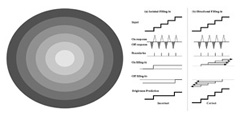
The filling-in theory of brightness perception has gained muchattention recently owing to the success of vision models. However, thetheory and its instantiations have suffered from incorrectly dealingwith transitive brightness relations. This paper describes an advancein the filling-in theory that overcomes the problem. The advance isincorporated into the BCS/FCS neural network model, which allows itfor the first time to account for all of Arend's test stimuli forassessing brightness perception models. The theory also suggests a newteleology for parallel ON- and OFF-channels.